
Episode 02
The Wilhelm Gustloff
Told by those who survived
- Period
- January 1945
- Place
- Gotenhafen and the Baltic Sea
- Runtime
- 30:07
- Status
- Released October 4, 2026
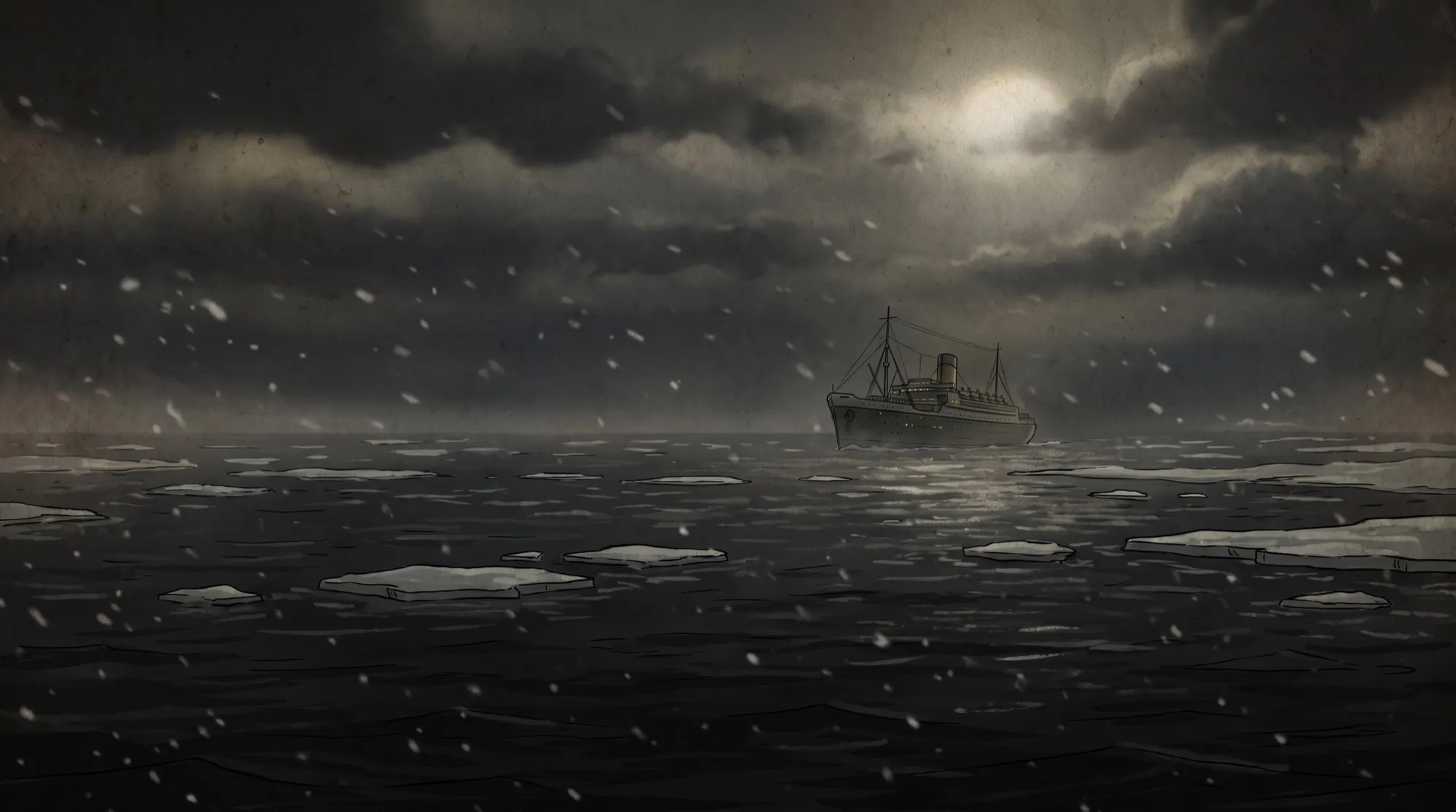
Illustrated reconstruction. The Baltic, 30 January 1945.
On 30 January 1945 a former cruise liner left Gotenhafen with refugees, wounded soldiers and navy trainees aboard. That night three torpedoes hit her. The episode follows a ten-year-old boy, a mother of three, a navy doctor and a sailor's family through the sinking and the months after, and asks why no one can say how many died.
The story
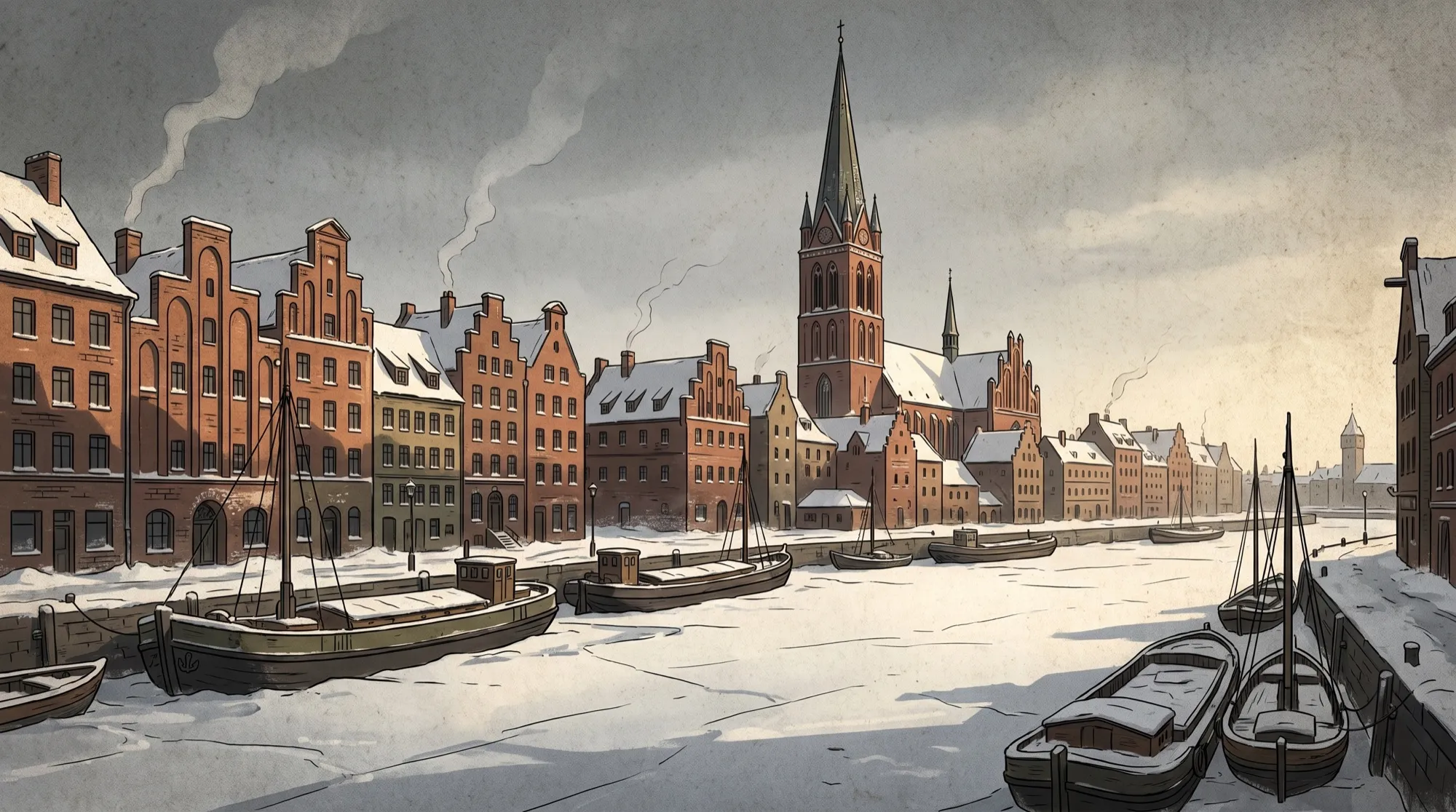
In January 1945 the Red Army's winter offensive, which opened on 12 January, reached East Prussia. The Nazi Party there, under Gauleiter Erich Koch, had forbidden civilians to evacuate. Families left late, and in winter. By 25 January Soviet armour had reached the Frisches Haff and cut the roads west. On 23 January Grand Admiral Karl Dönitz had ordered the navy to evacuate by sea. That operation, Hannibal, moved more than a million people.
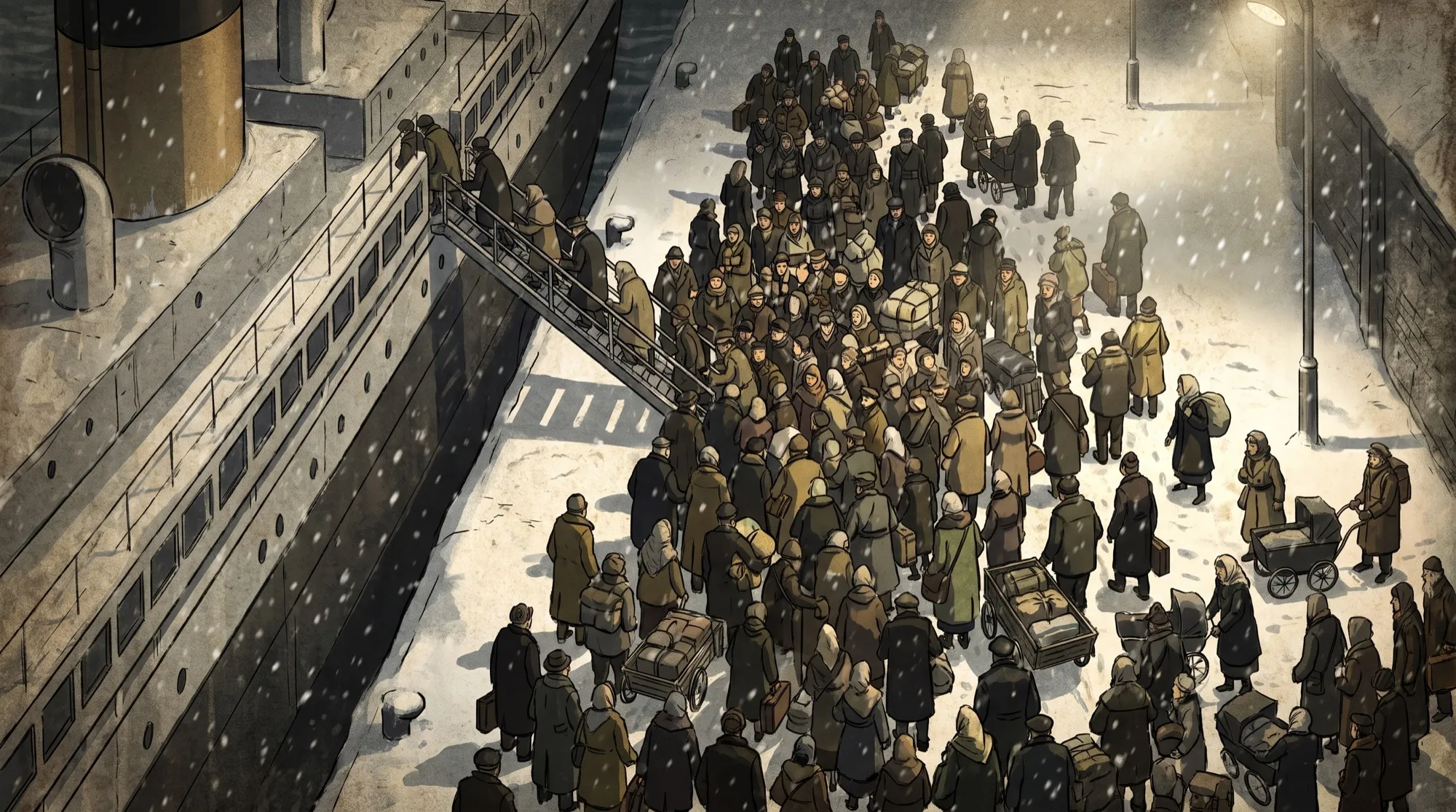
The Wilhelm Gustloff was launched in 1937 as a Strength Through Joy cruise ship built for 1,465 passengers. From 1939 she was a hospital ship. From November 1940 she was floating barracks at Gotenhafen for a U-boat training division: painted grey, fitted with anti-aircraft guns, no longer protected as a hospital ship. On 30 January 1945 she sailed with U-boat trainees, women naval auxiliaries, wounded soldiers, crew, and refugees in every space that had a floor. Nobody wrote all of them down.
She took the deep-water Route 58, about 20 nautical miles offshore, at 10 to 11 knots, with a weak escort. That evening the Soviet submarine S-13, commanded by Alexander Marinesko, attacked on the surface from the landward side. Three torpedoes hit: the bow, the drained swimming pool where the women auxiliaries were quartered, and the engine room. The ship's senior second officer, Paul Vollrath, timed the first hit at 21:09. She sank bow first at about 22:10, in 44 metres of water.
The air was well below freezing and the sea was near freezing, with ice on the surface. Many of the dead died in the water, not inside the ship. Rescue ships, led by the torpedo boat Löwe and later T-36, pulled people from the sea through the night and landed them at Kolberg, Sassnitz and Swinemünde.
Then families waited. Walter Salk's mother wrote to him on 1 February. The letter came back. He was listed missing in December 1945 and confirmed dead on 28 September 1946, twenty months after a sinking that took an hour.
- 1,465
- Passengers the ship was designed to carryWikipedia (MV Wilhelm Gustloff); one research file gives about 2To verify
- 7,000 to 10,000+
- People aboardFalk letter (~7,000); Rittner/Hoehling (7,936); Schön (10,000+)Disputed
- 9,343
- DeadSchön, Die Gustloff-KatastropheDisputed
- 1,252
- RescuedSchön; VollrathDisputed
- 3 of 373
- Women naval auxiliaries who survivedSchön via WikipediaTo verify
People
Documented individuals first. Composite figures, drawn to stand for people the sources describe without naming, are listed separately and never presented as real.
Horst Woit
Passenger, aged 10, from Elbing, East Prussia
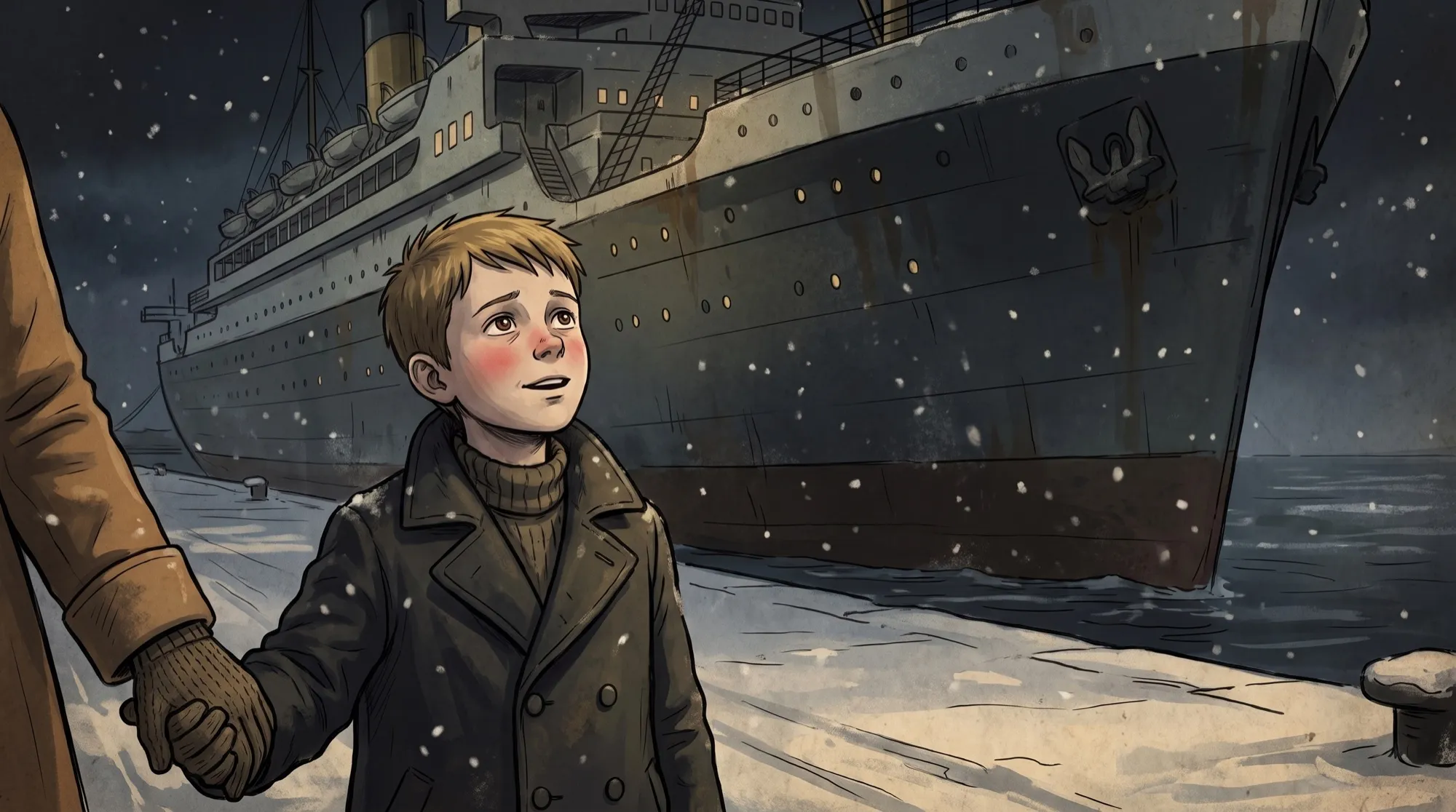
Fled with his mother Meta by small boat and on foot. Slept through the first torpedo. In a lifeboat hanging on frozen ropes he handed over a jackknife from his uncle's things, and a man cut the boat free. Rescued by the Löwe. Emigrated to Canada in 1953.
Source: Wilhelm Gustloff Museum account of a 2005 interview, narrated by David Krawczyk. Not Horst's own words.
Meta Woit
Passenger, Horst's mother
Rescued separately from her son. She searched the Löwe for him and found him alive.
Source: Wilhelm Gustloff Museum account.
Betty Falk
Passenger, mother of three; wife of a marine
Boarded with a two-year-old son and two daughters, Helga and Edith. An explosion threw her into the air and back onto the deck, and a wave took them into the sea. She lost the children. She landed at Kolberg with a blanket and took twelve days to reach her parents.
Source: Her letter to her sister Irma, Selsingen, 18 February 1945. Wilhelm Gustloff Museum.
Hans Rittner
Navy doctor examining refugees and wounded at boarding
Reached a flooded lifeboat with frozen hands. A girl of about ten in the boat kept asking for her mother. Landed at Sassnitz on Rügen.
Source: "I Survived History's Worst Sea Disaster," as told by A. A. Hoehling. A mediated account; we do not use its figures.
Walter Salk
Mechanic's mate, Kriegsmarine, aged 21
Born in Essen-Altenessen in 1923. Last letter home 14 January 1945. Listed missing in December 1945; death confirmed 28 September 1946. The record cannot tell us where he was aboard or how he died.
Source: Salk family letters, Wilhelm Gustloff Museum.
Paul Vollrath
Senior second officer
Gives the first impact at 21:09 and the sinking at 22:10. Says he had the navigation lights turned off. Estimated about 800 survivors.
Source: His account in Sea Breezes, April 1981.
Heinz Schön
Purser's assistant; survivor
Spent the rest of his life reconstructing the passenger list. His figures of more than 10,000 aboard and 9,343 dead are the ones most often quoted, and we always attribute them to him.
Source: Heinz Schön, Die Gustloff-Katastrophe (1984).
Alexander Marinesko
Commander, Soviet submarine S-13
Aged 32 and in trouble with his superiors. Sank the General von Steuben ten days later. Demoted in September 1945, died in 1963, named Hero of the Soviet Union in 1990.
Composite figures
The refugee mother
Composite figure
An unnamed mother used in early production to stand for many refugee families. She is not a documented individual and is not Meta Woit or Betty Falk.
Timeline
- 5 May 1937Launched at Blohm & Voss, Hamburg, built for 1,465 passengers in 489 cabins.
- Sep 1939Becomes Hospital Ship D.
- 20 Nov 1940Becomes floating barracks at Gotenhafen for the 2nd Submarine Training Division.
- 12 Jan 1945The Red Army's winter offensive opens.
- 14 Jan 1945Walter Salk writes his last letter home.
- 23 Jan 1945Dönitz orders evacuation by sea: Operation Hannibal.
Show the full timeline (16 entries)Show fewer
- 25 Jan 1945Soviet armour reaches the Frisches Haff, cutting the roads west.
- 30 Jan 1945, about noonThe ship leaves Gotenhafen. Accounts give noon, 12:30 and about 3 pm. Vollrath; Falk; secondary sources disagree
- 30 Jan 1945, 21:09Three torpedoes hit. Other accounts give 9:15 and 9:16 pm. Vollrath; Rittner
- 30 Jan 1945, about 22:10The ship sinks bow first in 44 metres of water. Vollrath
- 31 Jan 1945Survivors are landed at Kolberg, Sassnitz and Swinemünde.
- 1 Feb 1945Walter Salk's mother writes to him. The letter is returned.
- 18 Feb 1945Betty Falk writes to her sister from Selsingen.
- 18 Dec 1945Walter Salk is officially listed missing.
- 28 Sep 1946Walter Salk's death is confirmed.
- 1994Poland treats the wreck as a war grave. Diving within 500 metres requires permission.
What they faced
The crowd. The ship was designed for 1,465 passengers. The three counts of people aboard in our sources run from about 7,000 to more than 10,000. Mattresses were laid wall to wall in passageways and lounges. The 373 women naval auxiliaries were quartered in the drained swimming pool; the third torpedo hit beneath it.
The cold. Survivors describe air temperatures between −10 and −18 °C. The water was near freezing with floating ice. We do not state an exact water temperature, because no primary measurement has been found.
The boats. There were not enough places in the lifeboats, and the davits were coated in ice. Horst Woit's boat hung on ropes that had frozen. In the museum's account of his interview, he handed over a jackknife and a man cut the boat free.
The stairs. People were crushed on crowded stairs inside the ship, children among them. Watertight doors sealed crew inside the bow.
The rescue. A ship that stopped to pick people up became a target. Hans Rittner's rescue ship broke off to drop depth charges after torpedoes were sighted, and left people in the water.
Medical context
The people in the water were not killed by one thing. Modern cold-water research describes four overlapping stages, and the timings are rough guides, not a clock for any individual.
- Cold shock, in the first seconds to about three minutes: an involuntary gasp and rapid breathing. A gasp under water can be fatal on its own.
- Cold incapacitation, from about five to thirty minutes: the hands and limbs cool and stop working. Near 0 °C this can happen within five to fifteen minutes. A conscious person may be unable to grip a rope or climb into a boat.
- Hypothermia, often after twenty to thirty minutes: core temperature below 35 °C.
- Circum-rescue collapse: the body can deteriorate during the lift out of the water or in the hours after. Being pulled into a boat was not the same as surviving.
A life jacket keeps a person afloat. It does not stop cold shock and it does not insulate. That is why the episode says the people of the Gustloff died in the water, and does not say they all died of hypothermia. Hans Rittner, a navy doctor, reached a lifeboat three-quarters full of water and found his hands frozen solid.
Maps
Elbing, home of the Woit family, to the Bay of Danzig. Gotenhafen (Gdynia) and the route around Hela point into the Baltic. Route 58, about 20 nautical miles off the Pomeranian coast. S-13's patrol from Porkkala, Finland, to the waters off Kolberg. The sinking site in 44 metres of water off present-day Poland. The landing ports: Kolberg, Sassnitz on Rügen, and Swinemünde. Betty Falk's route on to Kiel and Selsingen.
Map in preparation. Routes and places will be drawn from period maps and the sources below, with every location labelled by its name at the time and today.
From the record
Words from the people who were there, or from the records made at the time. Translations and mediated accounts are labelled as such.
I have lost my 3 children and am now completely alone.
Our translation of the German original ("ich habe meine 3 Kinder verloren u. bin nun ganz allein"). The museum's English translation has two passages a German reader still needs to check.
There were about 7,000 people on board, predominantly women and children.
I realize my hands are frozen solid. I cannot move my fingers.
A mediated account, not Rittner's own writing. The original publication and year are not given.
What is still disputed
These are places where the sources disagree or the record is silent. We show the disagreement rather than resolve it artificially.
- How many people were aboard. The counts in our sources are about 3,000 people apart, because the people at the gangway were never all written down.
- The time of the first torpedo: 21:09 (Vollrath), 9:15 pm (Rittner), and a German reading of Betty Falk's letter that may say 9:07 pm.
- Whether the navigation lights were on. Vollrath says he had them turned off; other accounts say they burned after dark.
- Which warship passed without stopping. Hastings names the Admiral Hipper; Rittner's account names the Prinz Eugen.
Sources and further reading
- Sources listed
- 16
- Checked against the source
- 1
- Not yet checked
- 15
Show all 16 sourcesHide the source list
Primary source
Betty Falk, letter to her sister Irma, Selsingen, 18 February 1945. Wilhelm Gustloff Museum. View source
The page-one scan carries the museum's watermark and is not reproduced here without permission.
Not yet checked against the source
Archival document
Walter Salk family letters. Wilhelm Gustloff Museum. View source
Not yet checked against the sourceGerman Red Cross Tracing Service (DRK-Suchdienst). View source
Not yet checked against the source
Scholarly secondary source
Heinz Schön, Die Gustloff-Katastrophe (1984).
Source of the most-cited passenger and casualty figures.
Not yet checked against the sourceMax Hastings, Armageddon: The Battle for Germany 1944–45 (2004).
Not yet checked against the sourceAntony Beevor, Berlin: The Downfall 1945 (2002).
Not yet checked against the sourceTipton, M. J. (1989). "The initial responses to cold-water immersion in man." Clinical Science 77, 581–588. View source
Not yet checked against the sourceTipton, Eglin, Gennser & Golden (1999). "Immersion deaths and deterioration in swimming performance in cold water." The Lancet 354, 626–629. View source
Not yet checked against the source
Later recollection
Paul Vollrath, account in Sea Breezes, April 1981.
Not yet checked against the sourceHans Rittner, "I Survived History's Worst Sea Disaster," as told by A. A. Hoehling. Wilhelm Gustloff Museum. View source
Read in full. Mediated; its passenger and survivor figures are not used.
Checked against the sourceWilhelm Gustloff Museum, account of Horst Woit's 20 May 2005 interview with David Krawczyk and Marcus Kolga. View source
Not yet checked against the sourceHeinz Schön, interview, NDR. View source
Not yet checked against the source
Reference work
U.S. Coast Guard, National Search and Rescue Supplement, §3.7.2, "Four Stages of Cold Water Immersion."
Not yet checked against the sourceWikipedia, "MV Wilhelm Gustloff." View source
Used as a lead to other sources, never as the final word.
Not yet checked against the source
Historical interpretation
Smithsonian Magazine, "The Deadliest Disaster at Sea Killed Thousands, Yet Its Story Is Little-Known. Why?" View source
Not yet checked against the sourceThe National WWII Museum, "The Sinking of the Wilhelm Gustloff." View source
Not yet checked against the source
See an error or know a better source? Send a correction. Read how we research.
In the Knowledge Base
Terms from this episode, explained in full.
- Cold-water immersionWhat happens to a body that goes into cold water, in four overlapping stages, and why a life jacket was never enough.
- HypothermiaA fall in the body's core temperature below 35 °C. Often blamed for deaths it did not cause, and often present in deaths blamed on something else.
- Operation HannibalThe German navy's evacuation of soldiers and civilians across the Baltic in the first months of 1945, which moved more than a million people and cost several of the worst losses at sea in history.
- TriageSorting casualties by how urgently they need care and how likely care is to help, when there are more wounded than hands to treat them.
That's what it cost.
Watch next
The Halifax Explosion
On 6 December 1917 the burning munitions ship Mont-Blanc exploded in Halifax Harbour, killing roughly 2,000 people. This episode follows the doctors, children and families of Halifax and Dartmouth through the blast, the flying glass, the snowstorm that followed, and the weeks of care that came after.
The Road to Tenochtitlán
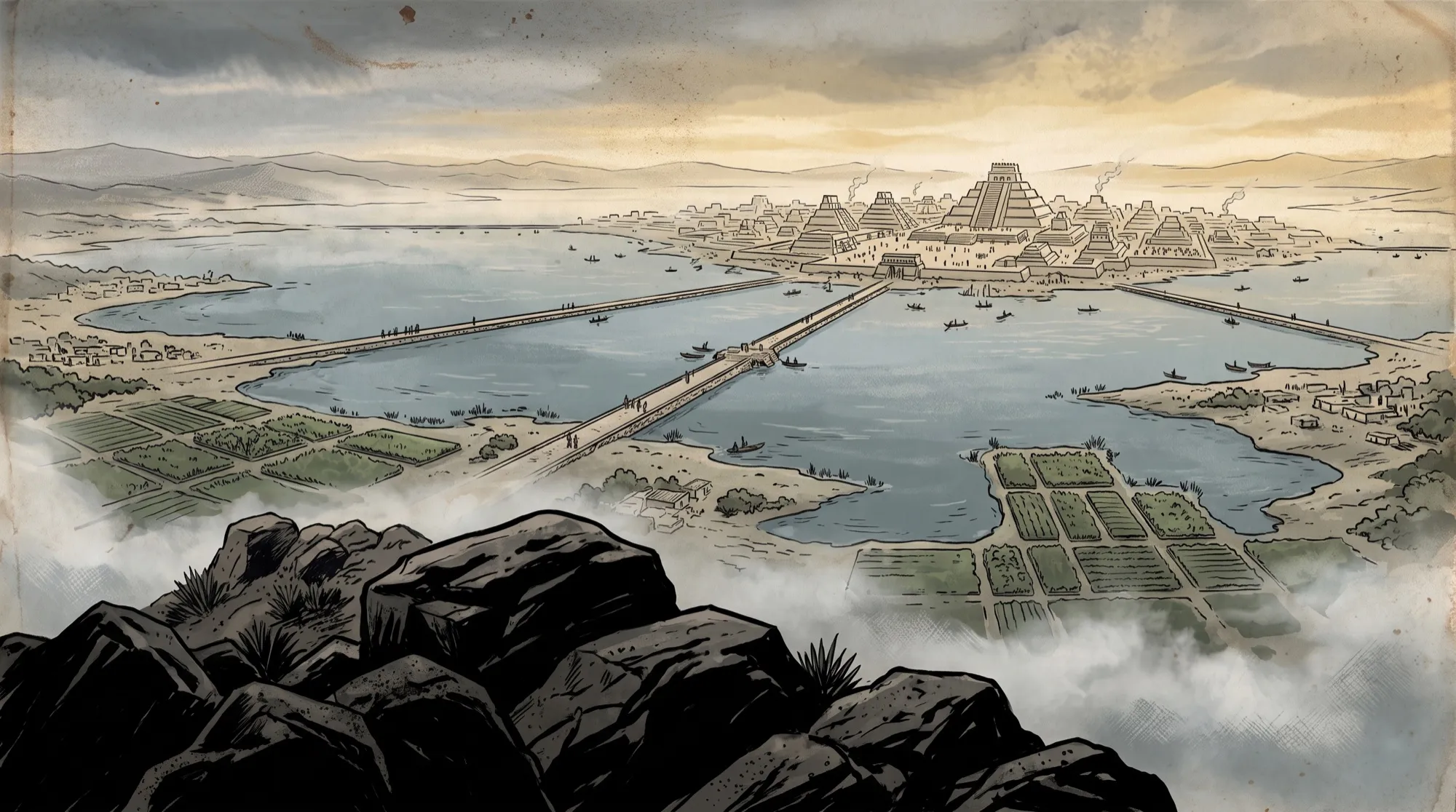
About five hundred Spaniards reached Tenochtitlán in November 1519, but they did not walk the road alone. This episode follows the interpreters, the Totonac and Tlaxcalan allies, and the porters who carried the expedition inland, and the people of Cholula who paid for decisions made by others.