
In production
The Hands That Survived Rome
A legionary, a physician, and the weeks after the injury
- Period
- About AD 35
- Place
- Vindonissa, on the Upper Rhine frontier (modern Windisch, Switzerland)
- Runtime
- About 20 minutes (planned)
- Status
- In production

In production. The documentary is not released yet. The research below is published as it is checked.
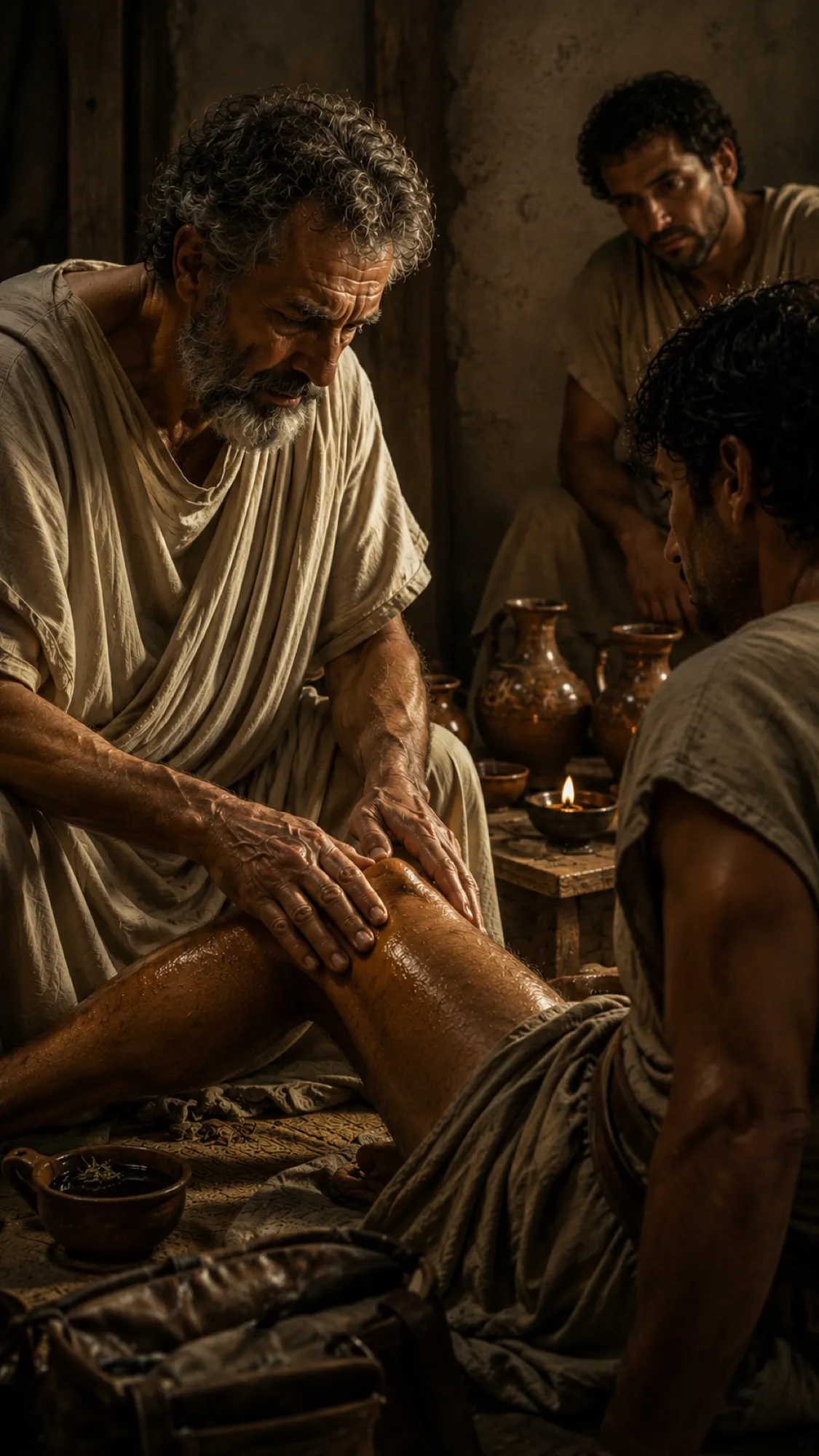
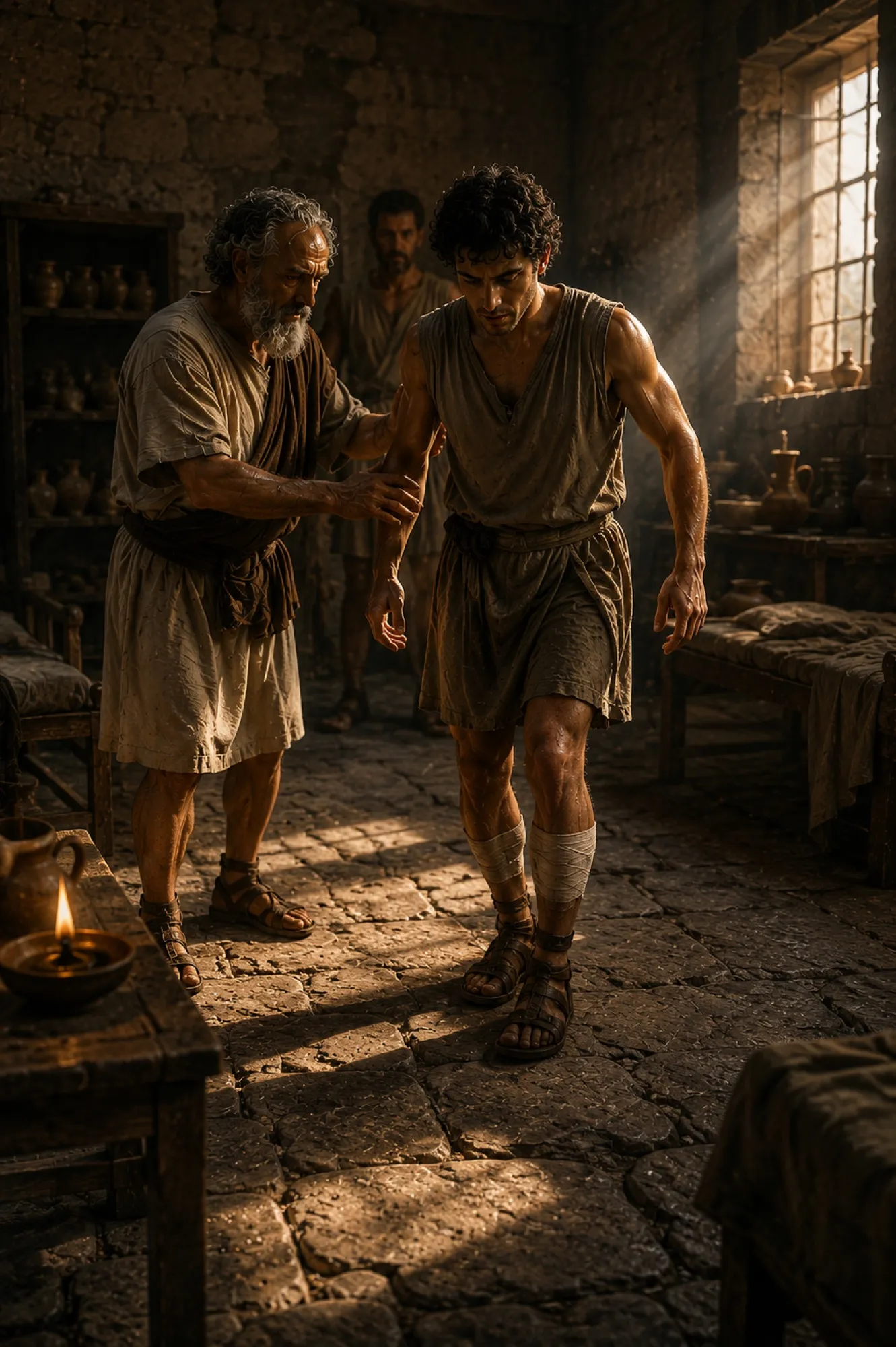
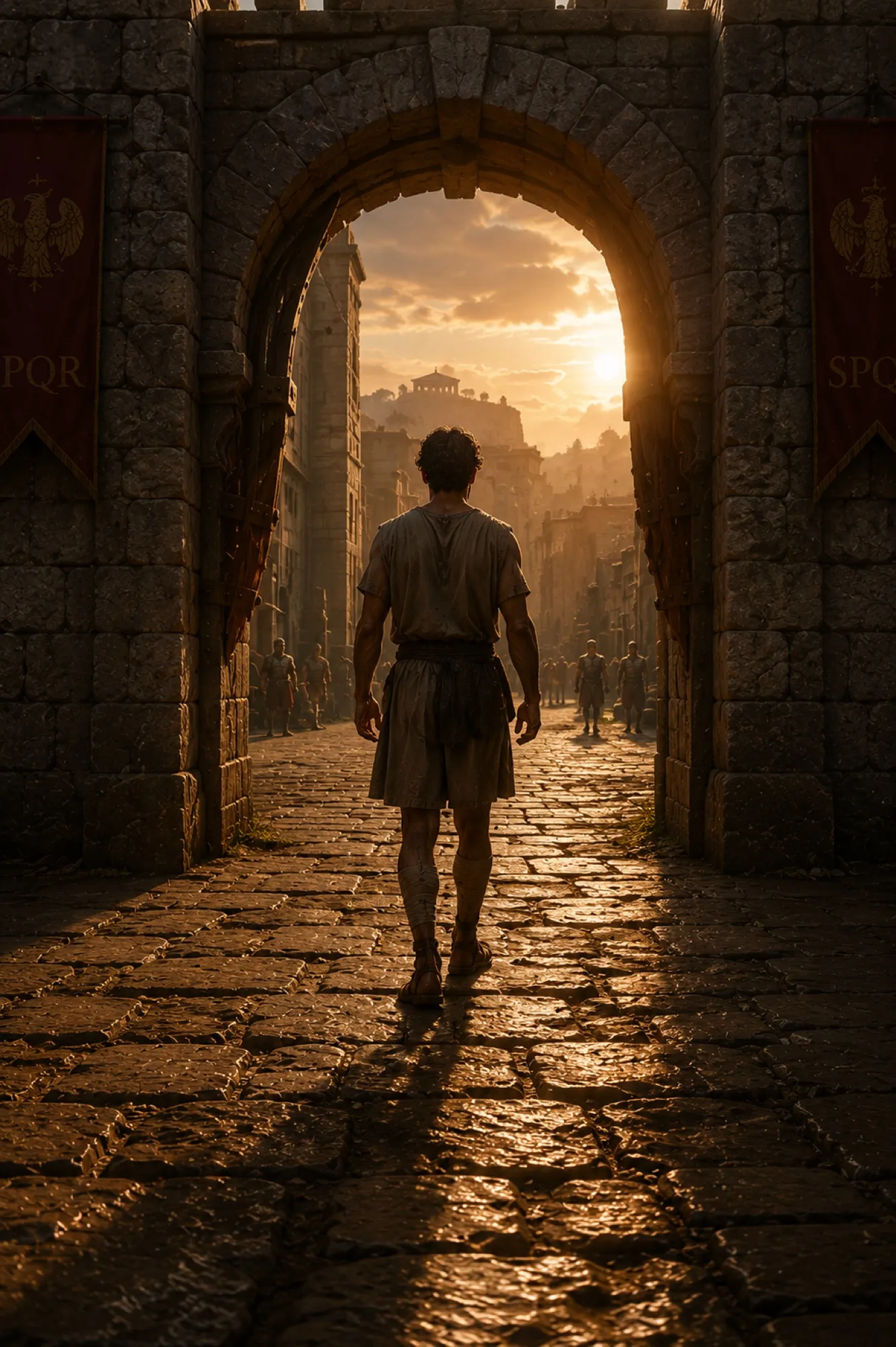
Production still from the 60-second cut. The stone ward shown here belongs to a later phase of the camp than the full documentary depicts.
A legionary at Vindonissa around AD 35 dislocates his knee in a training collision. A military physician puts the joint back with traction and his hands. The film follows the slow recovery after, and the question of whether a man who can walk can still serve as a soldier.
The story
The documentary follows Marcus, an ordinary legionary of about twenty-five, some six years into his service with Legio XIII Gemina at Vindonissa around AD 35. Marcus is a composite. He never existed as one person. His setting, his injury and his treatment are assembled from the archaeology of Vindonissa, ancient medical texts, and what is known of legionary life.
On the exercise ground outside the camp, another soldier hits him from the side while his foot is planted. His knee dislocates. The injury is closed: no broken skin, no major bleeding. That choice is deliberate. It keeps survival plausible and keeps the story on what happened next. No source records this accident, and we do not claim that training often caused injuries like it.
His treatment follows the order the Roman medical writer Celsus describes in De Medicina, Book VIII: examination by sight and touch; reduction, with traction separating the bones while the physician restores the joint by hand; rest while the joint is inflamed; hot water after the fifth day; rubbing only once the inflammation has settled; and then use of the limb when movement no longer hurts. Older Greek writings in the Hippocratic tradition had already warned about long inactivity and about returning to exertion too fast. None of this is modern physical therapy, and we do not call it that.
Marcus walks again. He cannot reliably carry, turn, train or hold formation under load. The film introduces missio causaria, discharge for a soldier no longer fit to serve. We do not know the exact procedure at Vindonissa in AD 35, so the film does not show one. Marcus takes off his equipment, leaves his eight-man barrack room, and walks out through the gate. What he did after that is left unknown on purpose.
- 8
- Men to a barrack roomMuseum AargauTo verify
- 3 to 5
- Days of rest after reduction, per Celsus, longer for stronger jointsCelsus, De Medicina, Book VIIITo verify
- 20 years
- Service needed after AD 213 for a medically discharged soldier to receive full veteran privilegesVan Lommel 2013To verify
People
Documented individuals first. Composite figures, drawn to stand for people the sources describe without naming, are listed separately and never presented as real.
Aulus Cornelius Celsus
Roman medical writer
Author of De Medicina, written under Tiberius. The source the episode's treatment sequence follows.
Anicius Ingenuus
Medicus ordinarius, First Cohort of Tungrians
A military physician who died at 25 while serving at Housesteads on Hadrian's Wall. Known from his tombstone. A later period than the episode, cited as evidence that the rank existed.
Source: Campbell 2012, p. 47
Aurelius Dassius
Medically discharged soldier
Discharged after 19 years. His epitaph uses the language of an honourable discharge.
Source: Van Lommel 2013, pp. 70–72
Composite figures
Marcus
Legionary, Legio XIII Gemina, aged about 25
Built from Vindonissa archaeology, ancient medical texts and contextual evidence. His name, age, origin and length of service are reconstruction.
The physician
Military physician at Vindonissa
Unnamed. His methods, which are to observe, compare, palpate, manipulate, wait, rub and reassess, are assembled from what the medical texts describe.
Timeline
- Reign of AugustusOrganised military medicine: physicians, capsarii, and buildings interpreted as hospitals. Wilmanns (abstract)
- AD 14–37Reign of Tiberius. Celsus is writing De Medicina in Italy.
- About AD 30–45Legio XIII Gemina holds Vindonissa; some 5,000 to 6,000 soldiers. Museum Aargau
- About AD 35The episode's setting.
- AD 45/46Legio XIII Gemina leaves Vindonissa. Princeton Encyclopedia of Classical Sites
- AD 213Caracalla limits full veteran privileges to medically discharged soldiers with at least 20 years' service. Van Lommel 2013, p. 68
What they faced
The barrack room. Eight men shared two rooms. Museum Aargau's reconstruction of the soldiers' quarters at Vindonissa is tied to about AD 30–45, when Legio XIII held the site, with some 5,000 to 6,000 soldiers in the camp.
The work. A legionary had to carry equipment, move in formation, train, stand guard, dig and build. Vindonissa's archaeology shows barracks, workshops and a 2.4 km aqueduct, all built by soldiers. Walking was not the same as soldiering.
The cost of leaving. Discharge before the end of service could mean losing years of predictable pay. Later Roman law gave medically discharged veterans privileges close to those of an honourable discharge, but how much of that applied in AD 35 is uncertain.
Medical context
Who treated him. Under Augustus the army organised physicians (medici), assistants such as capsarii, and buildings long interpreted as hospitals (valetudinaria). Scholars still debate how confidently those buildings can be identified. An older assumption, that most Roman army doctors were Greek, is challenged by the epigraphic evidence.
What the physician knew. He could recognise a dislocation and inflammation, and he understood what rest and use did to a joint. He did not think in ligaments, nerves or blood vessels. Modern medicine knows a dislocated knee can damage all three. That explanation is ours, not his, and the film labels it as modern.
What we do not claim. That Marcus was sedated for the reduction. Opium, mandrake and wine were known, but their use in his case is not established. That a modern-style chain of stretcher-bearers and ambulances existed at Vindonissa. The exact evacuation route is uncertain.
Maps
Vindonissa, modern Windisch in Switzerland, on the Upper Rhine frontier. The camp under Tiberius covered roughly 20 hectares and was built in wood and clay; the stone camp, including the hospital known from excavation, belongs to later phases. The exercise ground lay outside the walls; the civilian settlement beyond the west gate.
Map in preparation. Routes and places will be drawn from period maps and the sources below, with every location labelled by its name at the time and today.
What is still disputed
These are places where the sources disagree or the record is silent. We show the disagreement rather than resolve it artificially.
- Whether a permanent hospital building stood at Vindonissa in AD 35, or only a timber predecessor or field infirmary.
- How medical discharge actually worked in the early first century AD. Most of the evidence is later Roman law.
- Whether the Greek term anatripsis is the right name for the rubbing the film shows.
Sources and further reading
- Sources listed
- 14
- Checked against the source
- 0
- Not yet checked
- 14
Show all 14 sourcesHide the source list
Primary source
Celsus, De Medicina, Book VIII (dislocations, reduction, aftercare). Trans. W. G. Spencer, Loeb Classical Library, 1938. View source
Not yet checked against the sourceCelsus, De Medicina, Book II (rubbing, exercise, convalescence). Trans. W. G. Spencer. View source
Not yet checked against the sourceHippocratic Corpus, On the Articulations. View source
Not yet checked against the sourceHippocratic Corpus, On Regimen in Acute Diseases, Appendix, Part 25. View source
Not yet checked against the source
Scholarly secondary source
Baker, Patricia A. "The Roman Military Valetudinaria: Fact or Fiction?" View source
Not yet checked against the sourceBader, Pascal. "Roman army medical staff." View source
Not yet checked against the sourceWilmanns, J. C. "The physician in the Roman army." (abstract only read) View source
Not yet checked against the sourceVan Lommel, K. (2013). "The terminology of the medical discharge and an identity shift among the Roman disabled veterans." Ancient History Bulletin 27, 65–74.
Not yet checked against the sourceCampbell, D. B. (2012). "Medics amongst the milites: Did the Roman army have a medical corps?" Ancient Warfare 6(4), 46–51.
Not yet checked against the sourceJackson, Ralph. Doctors and Diseases in the Roman Empire. University of Oklahoma Press, 1988.
Not yet checked against the sourceSalazar, Christine F. The Treatment of War Wounds in Graeco-Roman Antiquity. Brill, 2000.
Not yet checked against the source
Reference work
Princeton Encyclopedia of Classical Sites, "Vindonissa." View source
Not yet checked against the source
Historical interpretation
Museum Aargau, Soldiers' quarters (contubernia), Vindonissa. View source
Not yet checked against the sourceMuseum Aargau, Military hospital (valetudinarium), Vindonissa. View source
Not yet checked against the source
See an error or know a better source? Send a correction. Read how we research.
In the Knowledge Base
Terms from this episode, explained in full.
- CapsariusA Roman soldier who gave first aid to the wounded, named for the case (capsa) of dressings he carried. A trained legionary, not a non-combatant.
- Missio causariaRoman discharge from the army because a soldier was no longer physically or mentally fit to serve. What a soldier received depended on when, and how long he had served.
- Reduction of a dislocationPutting a dislocated joint back in place. Celsus described doing it with traction and the hands, then a strict order of rest, heat, rubbing and use.
- ValetudinariumA building inside a Roman fortress long interpreted as a military hospital. Some were large and carefully planned; how confidently we can identify them is still debated.
That's what it cost.
Watch next
The Halifax Explosion
On 6 December 1917 the burning munitions ship Mont-Blanc exploded in Halifax Harbour, killing roughly 2,000 people. This episode follows the doctors, children and families of Halifax and Dartmouth through the blast, the flying glass, the snowstorm that followed, and the weeks of care that came after.

The Wilhelm Gustloff
On 30 January 1945 a former cruise liner left Gotenhafen with refugees, wounded soldiers and navy trainees aboard. That night three torpedoes hit her. The episode follows a ten-year-old boy, a mother of three, a navy doctor and a sailor's family through the sinking and the months after, and asks why no one can say how many died.